
 vanessa
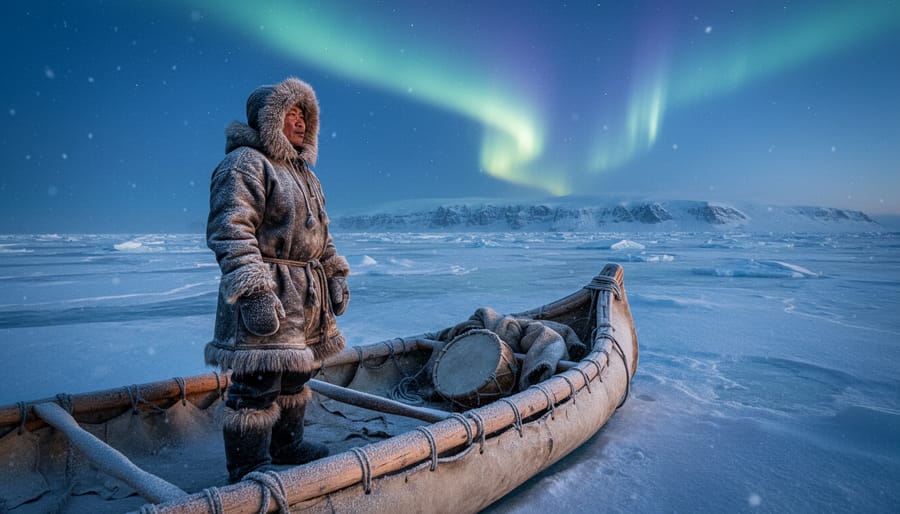
The Inuit are the indigenous peoples of the Arctic regions spanning Alaska, Canada, and Greenland, whose ancestors adapted to one of Earth’s harshest environments over thousands of years through extraordinary ingenuity, deep ecological knowledge, and resilient cultural traditions. Understanding Inuit history means recognizing a living heritage that extends from ancient migrations across the Bering land bridge to contemporary sovereignty movements, revealing how these communities not only survived but thrived in conditions that would challenge even modern technology.
The story of the Inuit shatters common misconceptions about passive survival in frozen landscapes. These societies developed sophisticated hunting technologies, complex social structures, and navigational expertise that enabled them to flourish across vast territories where temperatures plunge to deadly extremes and darkness blankets the land for months. From the Thule culture’s expansion eastward around 1000 CE to the profound disruptions of European contact and colonization, Inuit history encompasses innovation, adaptation, and cultural continuity against relentless pressure.
This exploration traces the major periods that shaped Inuit civilization, examining the cultural practices and survival strategies that define their heritage, and highlighting the ongoing efforts to preserve and revitalize traditions in the 21st century. For educators, students, and anyone seeking authentic understanding of Arctic indigenous peoples, this history offers essential insights into human resilience, environmental harmony, and the importance of respecting indigenous knowledge systems. The Inuit experience stands as both a chronicle of survival and a testament to the enduring strength of cultures that refuse to be erased.
What Inuit History Means: Understanding Arctic Indigenous Heritage
Inuit history encompasses the lived experiences, cultural development, and ancestral knowledge of the Inuit peoples across the circumpolar Arctic. It represents thousands of years of human adaptation, innovation, and cultural continuity in one of Earth’s most challenging environments, told through indigenous voices and perspectives that center Inuit agency, resilience, and self-determination.
The Inuit are the indigenous peoples of the Arctic regions spanning northern Alaska, Canada, Greenland, and the easternmost tip of Russia. Unlike a single unified group, Inuit identity reflects diverse regional cultures united by shared linguistic roots, subsistence practices, and deep spiritual connections to Arctic lands and waters. Their history is not merely a record of survival but a testament to sophisticated knowledge systems, artistic traditions, and governance structures developed over millennia.
- Inuit
- The collective term for Arctic indigenous peoples of Canada, Greenland, Alaska, and Russia, meaning “the people” in Inuktitut. Plural form used when referring to the group as a whole.
- Inuk
- Singular form meaning “person” or “human being,” used when referring to an individual Inuit person.
- Kalaallit
- The Inuit people of Greenland, representing the majority population of Kalaallit Nunaat (Greenland) with their own distinct language and cultural practices.
- Inuvialuit
- The Inuit people of Canada’s western Arctic, primarily in the Northwest Territories and northern Yukon, with distinct dialects and regional traditions.
- Traditional Territories
- The ancestral lands, waters, and ice that Inuit peoples have occupied, used, and stewarded for generations, forming the foundation of cultural identity and subsistence practices.
What makes Inuit historical experience distinct is the remarkable continuity of cultural practices despite extreme environmental challenges and colonial pressures. While many indigenous peoples worldwide faced displacement from their territories, Inuit largely remained on their ancestral lands, maintaining hunting, fishing, and gathering traditions that connect contemporary communities directly to their ancestors. This continuity allows Inuit to draw on unbroken chains of knowledge passed through oral traditions, practical skills, and cultural teachings.
Inuit history also stands apart in its emphasis on self-determination in storytelling. Rather than accepting narratives written by outside observers, Inuit communities increasingly control how their history is researched, interpreted, and shared, ensuring that archaeological findings, museum exhibitions, and educational programs reflect indigenous knowledge systems and values rather than colonial frameworks.
How Inuit History Developed Across Millennia
Ancient Origins and Arctic Migrations
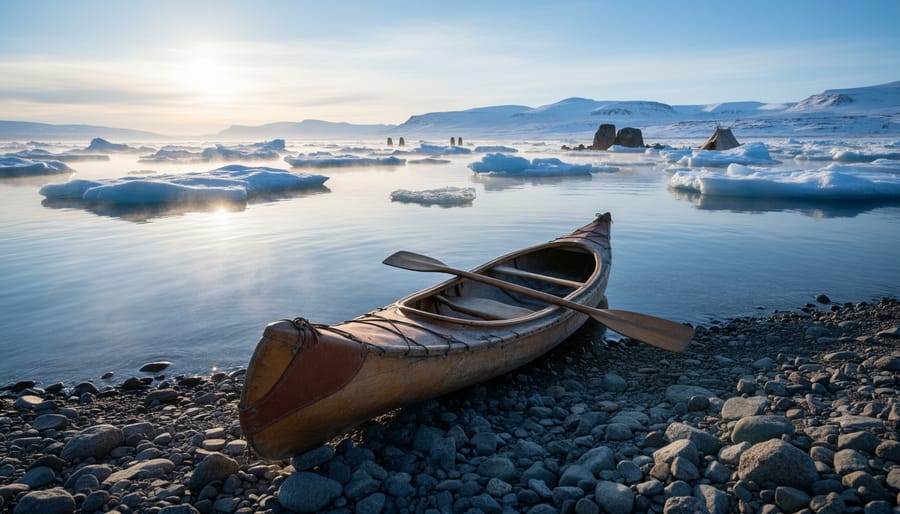
The ancestors of modern Inuit peoples began their remarkable journey across the Arctic approximately 1,000 years ago, emerging from what is now Alaska as the Thule culture. These skilled maritime hunters developed revolutionary technologies that allowed them to thrive in one of Earth’s harshest environments. Their invention of the umiak, a large, open skin boat capable of carrying entire families and their possessions, enabled unprecedented mobility across Arctic waters.
The Thule migration eastward represented one of the most rapid expansions in human history. Within just a few centuries, they had traveled from Alaska across the Canadian Arctic to Greenland, adapting their technologies and practices to each new region they encountered. They brought with them sophisticated tools including toggling harpoons for hunting seals and whales, dog sleds for winter travel, and insulated snow houses that provided warm shelter in extreme cold.
As the Thule moved east, they encountered and eventually replaced the earlier Dorset culture, whose people had occupied the Arctic for nearly 2,000 years before them. The reasons for this transition remain debated, but the Thule’s advanced hunting technologies and social organization gave them distinct advantages. Archaeological evidence shows they established permanent and seasonal settlements, developed complex trade networks, and created rich artistic traditions that laid the foundation for contemporary Inuit culture. Their descendants would carry forward this legacy of innovation and resilience.
Cultural Continuity and Transformation
Traditional knowledge systems did not remain static artifacts but rather evolved as living frameworks that Inuit communities adapted to new realities while preserving core cultural values. The strength of Inuit culture lay in its flexibility, allowing communities to assess new technologies and ideas without abandoning the wisdom that had sustained Arctic life for generations.
Language served as the primary vessel for cultural transmission. Inuktitut and related dialects carried not just vocabulary but entire worldviews, embedding ecological knowledge, social values, and spiritual understanding within their structure. Elders continued teaching younger generations through immersive participation rather than formal instruction, passing down hunting techniques, seasonal patterns, and navigational skills through direct experience and storytelling.
When Europeans introduced metal tools, firearms, and trade goods, Inuit communities selectively incorporated these technologies where they enhanced existing practices. Metal needles improved sewing efficiency without changing the fundamental art of skin preparation and garment construction. Rifles complemented rather than replaced traditional hunting knowledge, since success still depended on reading animal behavior and weather patterns.
Christianity’s arrival presented more profound challenges to cultural continuity. Many communities negotiated complex relationships with missionary influence, sometimes blending Christian elements with traditional spiritual practices, other times experiencing painful disruptions to ceremonies and social structures. Yet throughout these pressures, many families maintained connections to ancestral practices in quieter, more private ways.
The crucial mechanism of cultural survival was the decision-making authority communities retained over what to adopt and what to preserve. Even under colonial pressure, Inuit people continuously made conscious choices about which adaptations would strengthen their way of life and which compromises they would resist, ensuring their identity remained distinctly Inuit rather than becoming a diluted version of European culture.
Periods and Themes in Inuit Historical Experience
Pre-Contact Era: Thule and Dorset Cultures
The ancestors of today’s Inuit developed remarkable technologies and social systems that allowed them to thrive in one of Earth’s harshest environments. Two major cultural traditions shaped the pre-contact Arctic: the Dorset culture, which flourished from roughly 500 BCE to 1500 CE, and the Thule culture, which emerged around 1000 CE and became the direct ancestors of modern Inuit peoples.
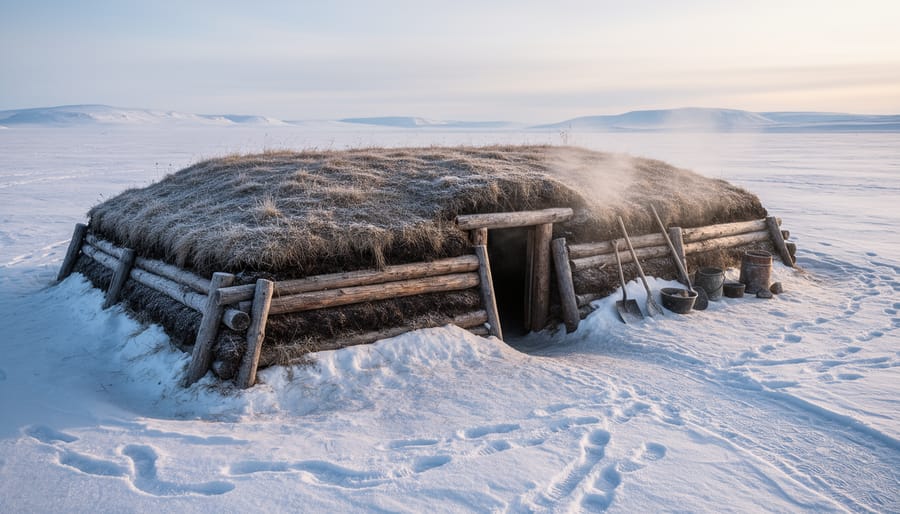
The Dorset people, known to Inuit oral traditions as the Tuniit, created intricate carved objects and developed specialized hunting techniques for seal and walrus. They lived in semi-subterranean winter houses and summer tent camps, crafting tools from stone, bone, and ivory with exceptional skill. Their artistic traditions produced delicate carvings that reveal sophisticated spiritual beliefs and deep knowledge of Arctic animals.
Around 1000 CE, Thule people began migrating eastward from Alaska across the Canadian Arctic to Greenland. They brought revolutionary innovations: large skin boats called umiaks for whale hunting, dog sleds for winter travel, and more efficient toggling harpoons. The Thule developed ingenious snow houses, sophisticated skin clothing systems with layered insulation, and extensive trade networks spanning thousands of kilometers. Their oral histories, passed down through generations, preserve detailed knowledge of migration routes, seasonal patterns, and ancestral connections to specific places.
These cultures weren’t static. They adapted continuously to climate shifts, resource availability, and changing ice conditions, building the foundation for Inuit resilience that continues today.
Contact and Colonial Periods
European contact fundamentally disrupted Inuit societies, though communities adapted and resisted in ways that preserved cultural identity. Initial encounters with Norse explorers around 1000 CE were limited, but sustained contact began with 16th-century European whalers and intensified through fur trade networks in the 17th and 18th centuries. These interactions brought new materials and trade goods, but also introduced devastating diseases that decimated populations with no immunity to smallpox, influenza, and tuberculosis.
The fur trade economy pressured Inuit to shift from subsistence hunting toward trapping, creating dependencies on European goods and disrupting traditional seasonal movements. Missionaries arrived in the 19th century, establishing permanent settlements and schools that deliberately suppressed Inuit spiritual practices, language, and cultural transmission. Children were often removed from families and sent to residential schools where speaking Inuktitut was forbidden, a trauma whose effects persist across generations.
Colonial governments imposed sedentarization policies in the mid-20th century, relocating families from traditional territories into permanent settlements to assert sovereignty and facilitate administration. The RCMP and government officials enforced registration systems, assigned surnames, and distributed numbered identification discs that treated Inuit as subjects rather than self-determining peoples. Despite these assaults on autonomy, Inuit maintained kinship networks, adapted Christian teachings to incorporate traditional values, and retained knowledge systems that would fuel modern self-determination movements.
Modern Era and Self-Determination
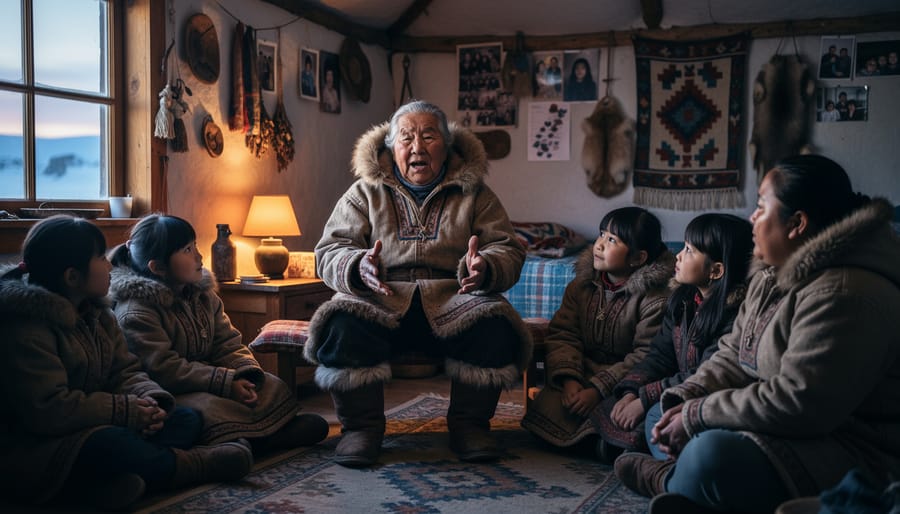
The mid-twentieth century marked a turning point as Inuit communities began reclaiming control over their lands, governance, and futures. The 1970s brought landmark land claims negotiations that recognized Inuit rights to vast Arctic territories. In 1999, Nunavut became Canada’s newest territory, the first jurisdiction in North America with an Indigenous majority government, representing decades of Inuit political organizing. Greenland achieved Home Rule in 1979 and expanded self-governance in 2009. Alaska Native Claims Settlement Act of 1971 established regional corporations giving Inuit communities economic tools alongside cultural preservation efforts.
Cultural revitalization movements gained momentum as Inuit reclaimed languages, traditional practices, and storytelling systems that colonial policies had attempted to suppress. Community-led initiatives restored throat singing, drum dancing, and carving traditions while adapting them for contemporary contexts, sometimes incorporating elements from pan-Indigenous movements like pow wow traditions that foster inter-tribal solidarity. Youth programs now teach survival skills alongside modern education, and Inuit-controlled media, schools, and cultural centers ensure knowledge passes to new generations on Inuit terms.
How Inuit History Is Preserved and Shared Today
Museums and Cultural Institutions
Inuit-led cultural institutions play a vital role in shaping how history is preserved and understood. The Inuvik Community Greenhouse in the Northwest Territories and Nunatta Sunakkutaangit Museum in Iqaluit exemplify community-driven spaces where Inuit curators and knowledge keepers control the narrative. These institutions prioritize oral histories, traditional artifacts, and contemporary art that reflect Inuit worldviews rather than colonial interpretations.
Indigenous museums across Canada increasingly feature Inuit perspectives through collaborative exhibits. The National Museum of the American Indian in Washington, D.C. has partnered with Inuit communities to present authentic voices in permanent galleries. Digital initiatives have expanded access significantly, virtual tours of Avataq Cultural Institute’s collections and online archives from the Inuit Heritage Trust allow global audiences to engage with historical photographs, maps, and recordings while respecting cultural protocols.
These institutions serve as meeting places where elders share knowledge with youth, researchers access community-approved materials, and visitors encounter history told by those who lived it. Cultural exhibitions now regularly include contemporary Inuit artists and thinkers who connect ancestral practices to present-day realities, demonstrating that preservation is an active, evolving process.
Oral Traditions and Elder Knowledge
Oral history remains the living foundation of Inuit historical knowledge. Elders transmit precise information about navigation routes, seasonal patterns, survival techniques, and cultural protocols through storytelling, a teaching method that has preserved knowledge for thousands of years without written records. These narratives aren’t simply stories; they encode practical wisdom, geographical information, and complex social histories in memorable forms that young people can internalize and pass forward.
The Inuktitut language itself carries historical meaning through place names that describe landscape features, past events, or resource locations. When elders share traditional stories, they often embed lessons about ethics, relationships with the land, and community values alongside factual historical details. This knowledge system proved remarkably accurate when researchers later verified elder accounts about ancient migration routes and archaeological sites.
Today, Inuit communities prioritize recording elder testimony before this irreplaceable knowledge is lost. Cultural programs pair youth with elders in land-based learning experiences where oral teaching happens naturally, during seal hunts, while preparing country foods, or while traveling traditional routes. Digital archives now preserve elder voices, but communities emphasize that recorded stories cannot replace the interactive dialogue and contextual learning that occurs when knowledge passes directly from elder to learner in authentic cultural settings.
Educational and Tourism Experiences
Indigenous-led tourism and educational programs offer visitors direct engagement with Inuit history through the voices of community members themselves. Cultural tours in regions like Nunavut, Nunavik, and Labrador connect travelers with Inuit guides who share traditional knowledge, demonstrate ancestral skills, and explain historical sites from their community’s perspective. These experiences range from dog sledding expeditions that reveal traditional transportation methods to archaeological site visits where guides interpret ancient dwelling remains and tool-making techniques.
Community-run cultural programs provide hands-on learning opportunities where participants might try throat singing, learn igloo construction principles, or prepare traditional foods using methods passed through generations. Schools and educational institutions increasingly partner with Inuit organizations to develop curriculum materials grounded in indigenous pedagogical approaches, ensuring history is taught accurately and respectfully.
Many programs connect broader Indigenous heritage themes to specific Inuit experiences, helping visitors understand both unique Arctic adaptations and shared indigenous values. Virtual programs now extend access to global audiences through online storytelling sessions, digital exhibitions, and interactive workshops led by Inuit educators. These initiatives serve dual purposes: generating economic opportunities for northern communities while ensuring Inuit history reaches audiences willing to learn from authentic sources rather than external interpretations.
How Inuit History Works
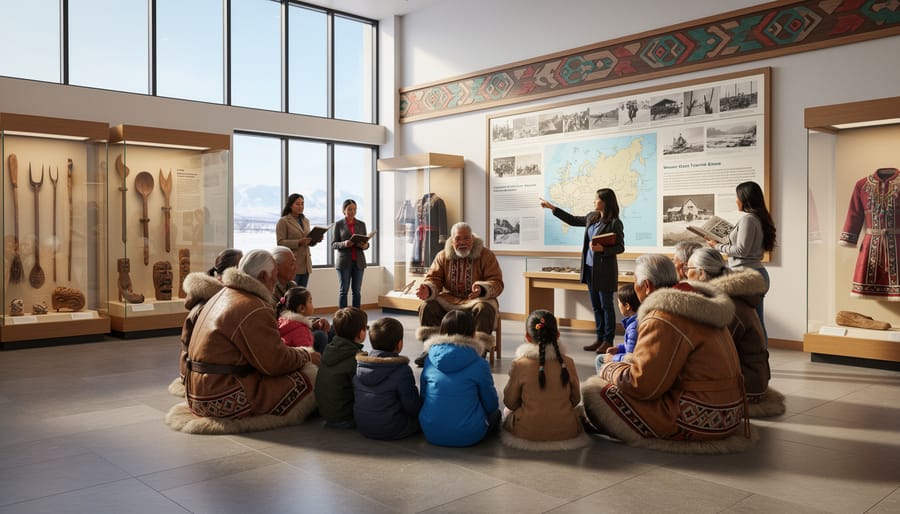
Inuit history operates through interconnected systems of knowledge transmission that have sustained culture across generations. Oral traditions form the foundation, elders share detailed accounts of ancestors, migrations, survival techniques, and spiritual practices through stories passed down with remarkable consistency. These narratives aren’t static records but living history that adapts to present contexts while maintaining core truths.
The archaeological record works alongside oral knowledge, revealing ancient settlements, tools, and hunting camps that confirm and expand traditional accounts. Modern researchers increasingly collaborate with Inuit knowledge keepers, recognizing that place names, seasonal patterns, and cultural practices encode sophisticated environmental understanding accumulated over millennia.
Language serves as another crucial mechanism. Inuktitut vocabulary preserves precise observations about ice conditions, animal behavior, and land features that reflect deep historical relationships with Arctic ecosystems. When elders teach traditional skills, building qamutiik sleds, reading weather signs, preparing country foods, they’re transmitting practical knowledge inseparable from historical experience.
This multi-layered approach means Inuit history works through continuous practice rather than purely retrospective study. Each generation actively participates in maintaining connections to the past while addressing contemporary realities.
Common Questions About Inuit History
Why is “Inuit” preferred over “Eskimo”?
The term “Eskimo” is considered offensive in many Arctic regions because it was imposed by outsiders and carries colonial associations. “Inuit” (meaning “the people” in Inuktitut) is the proper name Inuit use for themselves in Canada and Greenland, though related Arctic peoples in Alaska may use Iñupiat, Yup’ik, or other specific names.
Are all Arctic Indigenous peoples Inuit?
No. While Inuit are the Indigenous people of the Eastern Canadian Arctic, Northern Quebec, Labrador, and Greenland, other distinct Indigenous groups inhabit Arctic regions, including the Yup’ik and Iñupiat in Alaska, the Sami in northern Scandinavia, and various peoples in Arctic Russia. Each has their own language, culture, and historical experience.
How far back does Inuit history go?
Archaeological evidence traces Inuit ancestors back thousands of years, with the Thule culture (direct ancestors of modern Inuit) emerging around 1000 CE and spreading eastward across the Arctic. Earlier cultures like the Dorset inhabited Arctic regions before Thule arrival, and oral histories preserve knowledge spanning many generations beyond what archaeology alone can document.
Did Inuit live in igloos year-round?
No. Snow houses (igloos) were ingenious temporary winter shelters used primarily during hunting trips, not permanent homes. Traditional Inuit dwellings varied by season and region, including skin tents in summer, semi-subterranean sod houses in some areas, and various adaptations suited to local conditions and available materials.
These questions reflect genuine curiosities people bring when first learning about Inuit history, and answering them helps clear away misconceptions that can obscure deeper understanding. Terminology matters profoundly because language shapes how we perceive and respect distinct cultures. Recognizing that Arctic Indigenous peoples aren’t a monolithic group respects the rich diversity of northern cultures and the specific histories each community carries.
The timeframe question addresses a common tendency to view Indigenous histories as shallow or recent, when in fact Inuit connection to Arctic lands spans millennia of sophisticated cultural development. The igloo question tackles perhaps the most persistent oversimplification in popular imagination, the reduction of complex, varied Inuit material culture to a single iconic structure. Real Inuit history involves remarkable ingenuity in creating diverse shelter types adapted to specific needs, seasons, and landscapes.
Understanding these fundamentals opens space for appreciating the depth, complexity, and continuity that characterize actual Inuit historical experience rather than stereotyped versions.
Understanding Inuit history reveals a living heritage that continues to shape Arctic communities today. This isn’t simply a story preserved in archives or museums, it’s carried forward by Inuit people themselves through language revitalization, traditional practices, contemporary art, and political self-determination. Each generation adds new chapters while honoring ancestral knowledge that has sustained Arctic peoples for millennia.
Learning from indigenous perspectives transforms how we understand not just the past, but present relationships between cultures, lands, and peoples. Inuit-led narratives challenge colonial interpretations and offer profound insights into sustainable living, environmental stewardship, and cultural resilience that remain deeply relevant in our modern world.
You can engage directly with this vibrant culture through Inuit-operated museums, cultural centers, and guided experiences that welcome respectful learners. Community programs, virtual exhibitions, and indigenous tourism initiatives create opportunities to hear stories from knowledge keepers themselves. These authentic encounters support cultural preservation while enriching your understanding of humanity’s diverse ways of knowing and being. The invitation stands: approach with curiosity, humility, and genuine respect for the living tradition Inuit history represents.